
 ICAED and Convention on Disappearances
SIGNATURES AND RATIFICATIONS
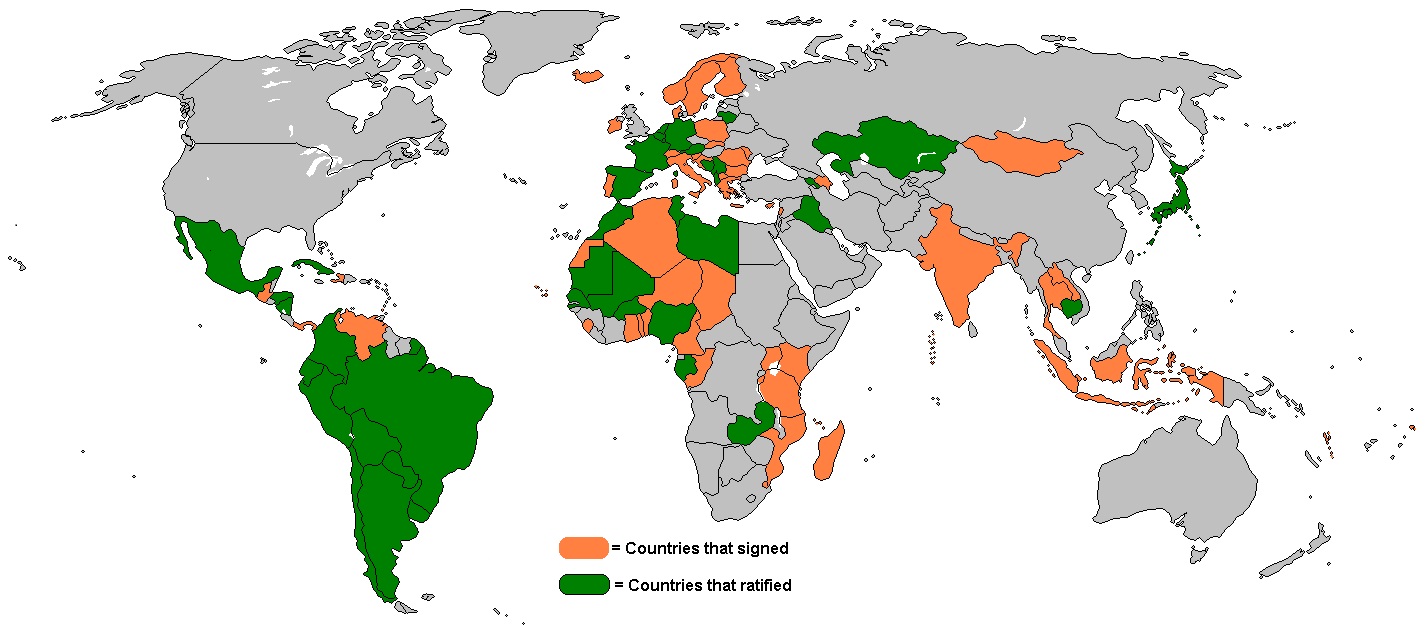
Signatures: 95
Most recent: Sri Lanka
Date: May 2016
Ratifications:
Most recent: Sri Lanka
Date: May 2016
View complete list of signatures and ratifications on UN website
Number of countries that recognise competence of the Committee to receive individual and interstate complaints: 19
Japan and Sri Lanka only accepted interstate complaints
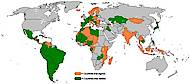
- Worldmap of signatures and ratifications
NEW MEMBERS OF ICAED
Latest member(s):
Belarusian House (Poland)
IDHEAS Litigio Estratégico en Derechos Humanos (Mexico)
FOCAL POINT OF ICAED
The focal point of the International Coalition against Enforced Disappearances is located at the secretariat of AFAD. Please contact the focal point for more information.
Mail: fpicaed@gmail.com
To strengthen the work for the convention please link this website to the website of your organisation.
07/14/16
COMISIÓN NACIONAL DE LOS DERECHOS HUMANOS (CNDH-RD) REALIZA VISITA A LA CÁRCEL DE LA VICTORIA
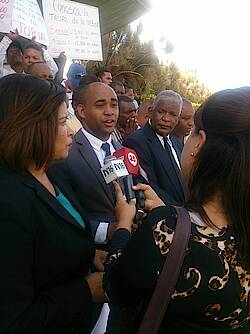
COMISIÓN NACIONAL DE LOS DERECHOS HUMANOS (CNDH-RD) REALIZA VISITA A LA CÁRCEL DE LA VICTORIA
La cárcel de La Victoria es una de las más grandes del país y se encuentra en Santo Domingo Norte. Es adscrita a la Dirección General de Prisiones y por lo tanto no hace parte del Nuevo Modelo Carcelario. Según datos del 20141 , de un total de 26,350 reclusos, 8,555 están recluidos en La Victoria, o sea el 32.5%. De ellos “3,232 tienen condenas de los tribunales (37.8%), mientras que 5,318 (62.1%) están en calidad de preventivos”.
Dado el elevado número de denuncias respecto a las condiciones infrahumanas de los reclusos y a los hechos violentos que allá periódicamente ocurren, una delegación de la Comisión Nacional de los Derechos Humanos integrada por el Licdo. Juan Alberto Francisco Vargas, coordinador del equipo legal de la CNDH y el Licdo. Zacarías Guzmán, integrante del mismo, el día domingo 19 de junio ha efectuado una visita a sorpresa a dicho penal.
RELATO
Una vez llegados a los alrededores de la cárcel La Victoria nos encontramos un mercado de ropa usada, zapatos, venta de productos agrícolas, comida y artículos de limpieza.
En el parqueo nos cobran 30 pesos, impuesto este que se le paga a la Junta Municipal de la Victoria. El dinero hay que pagárselo a un guardia que se encuentra en la entrada de la cárcel, este te entrega un ticket, con el cual te autorizan a parquear tú vehículo.
Nos dirigimos a la entrada de la cárcel para hacer una fila y comenzar el primer registro que consiste en entregar la cedula. Un policía hace el registro en una hoja y asigna un ticket, el cual hay que guardar para la salida. Lamentablemente este mismo policía que hace el registro, descuidando el reglamento y la forma, descaradamente nos pide una colaboración con “algo”, que quiere decir “dame dinero”. Si el visitante tiene un celular o algún objeto que esté prohibido entrar al penal, debe pagar 25 pesos por cada objeto para que te lo cuide una guardia que está en servicio, luego te pasan al segundo chequeo, te revisan y te estampan en la mano o en el antebrazo un sello rojo con el nombre del penal. Esto da paso al tercer chequeo en donde te piden la cedula y te ponen otro sello con el cual te dan acceso al penal.
En el recinto nos recibe un grupo de internos ofreciéndonos un servicio de guía, que hay que aceptar ya que esa es su forma de trabajo y de ganarse la vida dentro del penal.
Ya dentro del penal nos trasladamos a la Unidad de Atención Primaria de Salud y una vez allí nos damos cuenta que es necesario que sea intervenida con urgencia por las autoridades de Salud Pública ya que más que una unidad de salud parece un corral para cerdos, en donde se encuentran personas que supuestamente están internas por problemas de salud y que al parecer en ese lugar se le incrementarán.
Saliendo de esta unidad médica, entramos al patio y de una vez nos informan que un nuevo recluso se había ahorcado. Pudimos comprobar que se trataba de un señor que le había quitado la vida a una vecina por un conflicto por una pared.
Seguimos nuestro recorrido por el patio mientras que los privados de libertad nos cuentan una serie de inquietudes con relación a sus casos, los cuales a decir de ellos se mueren en los tribunales, ya que entran con una medida de prisión preventiva que se convierte en una pena anticipada porque duran hasta tres años en un limbo jurídico sin que su situación se define.
Nos encontramos con un señor condenado a 15 años de prisión. Hace más de un mes que cumplió su condena de 15 años y todavía no ha podido salir debido a que tiene una multa de 100 mil pesos y no tiene con qué pagarla. Como él hay decenas de casos. Otro caso que nos ha llamado la atención es el de un señor de nombre Marino Díaz, quien la Octava Sala de la Cámara Penal del Distrito Nacional con sentencia 162-2014 le ha otorgado la libertad por habérsele violado sus derechos constitucionales y fundamentales. El tribunal le envía el Oficio No.394 a la Magistrada Procuradora Fiscal JENNY BERENICE, el Oficio No.395 al Director General de Prisiones THOMAS HOLGUÍN LA PAZ, el Oficio No.396 al alcaide de la Penitenciaría Nacional la Victoria GILBERTO NOLASCO, pero estos funcionarios, a pesar de las comunicaciones desacatan una orden judicial en la cual se les notificaba la libertad de este señor.
LA COMIDA EN EL PENAL.
Hablando con los reclusos sobre cómo se sostienen y como hacen para alimentarse dentro del penal, nos dicen que hay un comedor donde la comida es gratis, que esta comida es preparada por un grupo de reclusos y es servida a los demás reclusos. Esta comida solo la comen aquellos que no tienen quien le supla una compra o dinero para comprar de la que venden dentro del penal, puesto que según ellos la comida que dan en el penal gratis le llaman “chao” en franca alusión a la comida para perros. Solo la forma en que es llevada a las celdas en cubetas hace que se parezca a desperdicio para puercos.
Los reclusos también se quejan de que la luz se va a veces desde las 9 de la mañana hasta las 6 de la tarde y esto les imposibilita cocinar en las estufas eléctricas por lo que se ven obligados a comprar a aquellos que tienen anafe de carbón, carbón que deben comprárselo a las autoridades del penal, lo que le incrementa el presupuesto que les asignan sus familiares para sobrevivir.
EL COSTO DE VIVIR EN UNA CELDA MÁS O MENOS DIGNA.
Cuando un preventivo llega a la penitenciaria de La Victoria, es llevado a una área conocida como “la planchita”, hasta tanto se le asigne una celda, si este elige una área determinada que tiene un costo, solo para que se te haga la solicitud de envío se deben pagar desde 500 hasta 30 mil pesos solo para el envío, pero esto no es el precio de la celda pues para dormir en una celda con cama debe pagar desde 250 pesos semanales hasta 1500 pesos solo por concepto de alquiler, pero si decide comprar una habitación te puede costar desde 25 mil pesos hasta 300 mil pesos.
Por ejemplo, una habitación en los F1 cuesta entre 40 mil y 50 mil pesos, al comprar tu habitación o mejor dicho cama porque en una habitación duermen 6 personas, esto te evita tener que estar pagando alquiler y una vez cumplida tu pena puedes vender esta cama, solo que si no lo hace antes de salir pues pierdes tu derecho de propiedad y esta es vendida por un oficial del penal. En el área B una habitación unipersonal cuesta entre 200 mil y 300 mil pesos, pues en comparación con el consulado y el patio este es un resort de cinco estrellas, destinado para personas con bastante recursos económicos, los cuales pueden pagar a otros reclusos para que les brinden seguridad y porque no, hasta policías para que sean sus escoltas.
Una cama en el área llamada ALASKA, que dicho sea de paso no sé si lo de Alaska es por lo estar frio, pues aquí hay otro tipo de reclusos con un perfil diferente, aquí nadie te pide porque pueden costar sus gastos e incluso algunos lujos que van desde gimnasio hasta masajes corporales, una cama en este lugar cuesta desde 20 mil hasta más de 100 mil pesos, pero hay quienes viven aquí por favores o gestiones realizadas por funcionarios del penal.
Si hacemos un cálculo de simple matemática podríamos decir que si en este penal en la actualidad hay más de 8 mil reclusos y si consideramos un pago medio de 400 pesos semanales solo para alquiler de celda, podríamos decir que esta práctica de negocio mueve más de 3 millones de pesos semanales, lo que en mercadeo sería un negocio muy rentable, ya que no hay que pagar impuestos y mucho menos empleados.
Es una lástima ver como nuestra juventud se está dejando llevar por los vicios, las malas influencias, la vanidad y el deseo de exhibir grandes lujos, el cual los lleva a la locura y a cometer cualquier delito para alcanzar aquello que quiere en el momento que lo desea sin medir las consecuencias. Es penoso ver que la gran mayoría de la población carcelaria en La Victoria es formada por jóvenes entre 19 y 35 años, jóvenes que en muchos casos están condenados a penas de 20 y 30 años de cárcel por distintos hechos.
La Victoria es el centro de corrección más grande de este país, construido para una población de no más de 2,500 reclusos, sin embargo supera los 8 mil. El hacinamiento es dramático, la corrupción es vergonzosa.
Las autoridades hablan de planes en contra de la delincuencia entendiendo que la solución a los problemas de la delincuencia está en matar a los delincuentes o en apresarlos y enviarlos a una cárcel para que cumplan una sanción, sin embargo las autoridades fomentan, promueven y patrocinan el crimen con su falta de interés en salir de este sistema que ya agonizó hace mucho tiempo en la República Dominicana, cuando está más que demostrado que el Nuevo Modelo de Gestión Penitenciaria es la mejor opción de rehabilitación, puesto que la reincidencia en el crimen en este nuevo modelo está por debajo del cinco por ciento. A pesar de esto las autoridades siguen invirtiendo en lo que se llama la universidad para el crimen, en donde el delincuente se profesionaliza y el que no era delincuente aprende métodos delincuenciales como forma de sustentamiento en caso de que sales de la cárcel y no consigues trabajo por los prejuicios de la sociedad, ya que de paso aprendiste un oficio para ganarte la vida recordando que siempre habrá un espacio para él en la cárcel.
Recomendaciones
1- Transformar la Penitenciaría Nacional de La Victoria en una cárcel del Nuevo Modelo de Gestión Penitenciaria.
2- Quitarle a la Policía Nacional y los demás cuerpos castrenses la seguridad y vigilancia de los reclusos y pasarla a un cuerpo especializado para el tratamiento de internos.
3- Consiguiendo el cambio de gestión tratar de que los reclusos se sostengan sin la ayuda de sus familiares, pues solo hay que trabajar con ese interno en base a un oficio o habilidad que este tenga y con los recursos generados por su trabajo este pude sostenerse y sostener a su familia.
4- Promover y crear una alianza entre la Universidad Autónoma de Santo Domingo (UASD) y el gobierno para que la UASD, que es la universidad estatal pueda conjuntamente con INFOTEP, hacer realidad el sueño de muchos de estos reclusos de realizar una carrera, aunque no sean todas pero hay carreras que no conllevan grandes logísticas para ser realizadas.
5- Crear las condiciones de dignidad para que el recluso se sienta como un ser humano.
6- Crear las bases para que los derechos humanos no sigan siendo violentados.
7- Que se cree una cárcel para las personas en régimen de prisión preventiva y no como el caso de La Victoria donde más del 60 % de los reclusos es preventivo.
8- Nos gustaría ver que el presidente de la República en una de sus visitas sorpresa se atreviera a visitar La Victoria, para que se lleve tremenda sorpresa, pues cuando vea en las condiciones en la que viven más de 8 mil hombres ordenara su demolición y así producirá el tan esperado decreto que incluirá la disolución de la Dirección Nacional de Prisiones y pasaría la administración de todas las cárceles de este país al Nuevo Modelo de Gestión Penitenciaria.
Santo Domingo, D.N. 12 de julio de 2016
The International Coalition Against Enforced Disappearances (ICAED) joins families worldwide in remembering the desaparecidos on the International Week of the Disappeared (IWD). The IWD is a time to reflect on the work that remains before every human rights advocate in the pursuit of truth and justice. This year, the ICAED calls on governments to ratify and implement the International Convention for the Protection of All Persons from Enforced Disappearance (Convention). ICAED also calls on civil society to hold its leaders accountable to the principles of human rights. Please click on title to continue reading.
On the night of August 4, 2018, police surrounded the home of Nusrat Jahan Sonia, a 25-year-old primary school teacher, in a rural area of Patuakhali district, south of Dhaka. They said she had “written something anti-state,” arrested her, and seized her mobile phone and laptop. Seven months pregnant, she was held for nearly two weeks for “spreading rumors” under section 57 of the Information and Communication Technology Act, simply because she shared a Facebook post that appealed for peace during an ongoing student protest demanding road safety. Her detention was renewed twice before she was eventually released on August 20, 2018. According to a family member, she has been suspended from her job at a government school. (Please click on title above to continue reading)
A repressive political environment in Bangladesh ahead of the December 30, 2018 national elections is undermining the credibility of the process, Human Rights Watch said in a report released today. Bangladeshi authorities should impartially investigate allegations of election violence and ensure that those responsible are held to account.
The 37-page report, “Creating Panic”; Bangladesh Election Crackdown on Political Opponents and Critics,” finds that authoritarian measures, including widespread surveillance and a crackdown on free speech, have contributed to a widely described climate of fear. While there have been violent attacks by supporters of all rival political parties, the authorities have failed to act impartially, Human Rights Watch said. The police have arrested and detained opposition members, but failed to act properly against ruling party supporters when they target opposition candidates. The report expands on Human Rights Watch findings earlier in December. (Please click on title above to continue reading)
ANTE EL MUNDO: la historia del Día de los Derechos Humanos debe impulsar a los Estados a instalar justicia y dignidad para los ciudadanos
La lucha de los pueblos en favor de los derechos humanos permanece vigente setenta años después de la adopción de la Declaración Universal de los Derechos Humanos. En el mundo entero se evidencia claramente la incongruencia entre el compromiso de los Estados de adherir a las normas internacionales de derechos humanos y la implementación de ellas en sus propios territorios. A pesar de algunos avances en determinados Estados occidentales, las graves violaciones a los derechos humanos constituyen un fenómeno cotidiano en la vida de los habitantes de nuestro planeta. (Please click the header above to read the full statement)
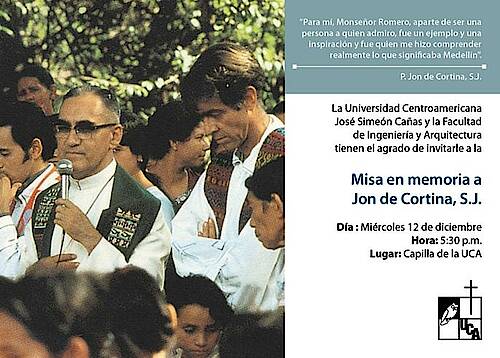
Misa en memoria Jon de Cortina 12 de diciembre - Capilla UCA
MONDE : La Journée internationale des droits de l'Homme devrait inspirer les États à rendre justice aux citoyens et à leur garantir le respect de la dignité humaine
70 ans après l’adoption de la Déclaration universelle des droits de l’homme, les peuples continuent leur lutte pour les droits de l’Homme. L’inconsistance entre les engagements pris par les Etats par l’adhésion à des normes internationales relatives aux droits de l’homme et leur mise en œuvre au niveau national est flagrante à travers le monde. Malgré certains développements institutionnels dans un certain nombre d'États occidentaux, les violations flagrantes des droits de l'homme sont le quotidien de nombreux citoyens. (Please click the header above to read the full statement)
WORLD: History of Human Rights Day should inspire States to afford justice and human dignity to citizens
The people's struggles for affording human rights continue after seventy years of adoption of the Universal Declaration of Human Rights. The inconsistency between the States' pledges to adhere to international human rights norms and implementing them domestically is strongly visible across the world. Despite certain institutional developments in a number of Western states gross violations of human rights are an everyday phenomena in the life of citizens born in our planet. (Please click the header above to read the full statement)
International Coalition Against Enforced Disappearances (ICAED)ß Meeting Name: 15th Session of the United Nations Committee on Enforced Disappearances (CED)
13 November 2018
Name of the Speaker: Rodrigo
Name of Organisation: International Coalition Against Enforced Disappearances (ICAED)
Meeting Name: 15th Session of the United Nations Committee on Enforced Disappearances (CED)
Madam Chairperson,
The International Coalition Against Enforced Disappearances (ICAED) works on improving the signature, ratification and accession of the International Convention for the Protection of all Persons from Enforced Disappearance. ICAED observes that the process of ratification to the Convention on Enforced Disappearances is very slow in comparison to the recurrence of the crime of enforced or involuntary disappearance.
ICAED and its members across the world are consistently doing advocacy, lobby and campaign in domestic, regional, and international levels to encourage more States to ratify the treaty for the objective of full implementation of the rights enshrined in it. ICAED is writing letters to the signatory States, as part of its campaign, requesting them to ratify the treaty and fully implement it in their domestic jurisdictions as one of the proofs of the States' commitment for extending cooperation to the United Nations human rights mechanisms.
ICAED is concerned over the political developments in several countries having growing number of enforced disappearances, although they are not State-party to the Convention yet. For example, law-enforcement agencies of Bangladesh and Pakistan in Asia are regularly disappearing the citizens of their countries. Continued non-cooperation with, and disregards to, the Special Procedures, such as the Working Group on Enforced or Involuntary Disappearances (WGEID), has now made the victims' families more vulnerable as there is no other resort left for them to seek redress.
Sri Lanka, being a state party since 2016, is plunged into another round of political crisis, which poses the threat to the process of addressing the issue of enforced disappearances. The current situation, if it persists, the cooperation with the CED is feared to be reduced and the safety of the families of the disappeared victims would be in jeopardy, as it had happened in the past under the Rajapakhsha government.
ICAED recommends the Committee on Enforced Disappearances (CED) to write to the signatory States (who are not a party to the Convention yet) and ask them to ratify the Convention.
The CED may consider the possibility of holding meetings in countries of state parties in different continents, as per its mandates, in cooperation with other international bodies and credible civil society organizations having track records of working on the issue of enforced disappearances. Such meetings may contribute more to see and share the best practices in affording reparation to the families. The Committee needs to consider the global political situation - the shifts towards populism and authoritarianism – and formulate its own plan of actions to address the challenges in the coming days in terms of upholding its mandate on dealing with enforced disappearances.
The ICAED supports the CED in its goal to achieve 100 percent additional ratifications in the next five years. Moreover, it also supports the CED’s important concern and priority on the very serious problem of enforced disappearances in relation to migration. States Parties to the Convention should reflect on their existing laws and ensure that there is consistency with their application vis-à-vis the right of all persons not to be subjected to enforced disappearance.
Thank you,
Madam Chairperson.
La Coalición Internacional contra las Desapariciones Forzadas (ICAED) se solidariza con los desaparecidos del mundo entero y sus familias conmemorando el día internacional de los desaparecidos 2018. En el octavo año desde que las Naciones Unidas pusieron en vigor la Convención Internacional para la Protección de Todas las Personas contra las Desapariciones Forzadas (Convención), la comunidad mundial fue testiga de desarrollos en la lucha contra las desapariciones forzadas: actualmente hay 97 Signatarios y 58 Estados Partes en la Convención. Varias leyes nacionales que penalizan la DF también se han promulgado en todo el mundo.
08/30/18
Déclaration de l’ICAED pour la journée internationale des victimes de disparitions forcées 2018
La Coalition Internationale Contre les Disparitions Forcées (ICAED) exprime sa solidarité envers les personnes disparues dans le monde entier, ainsi que leurs familles, en cette journée internationale des victimes de disparitions forcées. Depuis que la Convention internationale pour la protection de toutes les personnes contre les disparitions forcées (ci- après, la Convention) est entrée en vigueur il y a huit ans, des avancées ont pu être constatées : la Convention compte aujourd’hui 97 pays signataires et 58 États parties à la Convention, et plusieurs pays ont mis en place des lois criminalisant les disparitions forcées.
The International Coalition Against Enforced Disappearances (ICAED) stands in solidarity with all the world’s desaparecidos and their families as we commemorate this year’s International Day of the Disappeared (IDD). On the eighth year since the United Nations put the International Convention for the Protection of All Persons from Enforced Disappearances (Convention) into force, the global community has seen developments in the struggle against ED : there are currently 97 Signatories and 58 States-Parties to the Convention. Several domestic laws criminalizing ED have also been enacted around the world.
Please the title to read the full statement
Montevideo, 31 de julio de 2018.
Con profundo dolor y preocupación vemos el desarrollo de los acontecimientos en los últimos meses en Nicaragua.
Quienes de distintos lugares hemos peleado contra la desaparición forzada y la violación de los derechos humanos en cualquier lugar del planeta y particularmente en nuestra querida América Latina supimos hermanarnos en acciones conjuntas a través de la hoy desaparecida FEDEFAM con los hermanos pueblos de Argentina, Chile, Colombia, Guatemala, El Salvador, Méjico y demás pueblos de América. Incluso, enviando delegaciones en pleno conflictos como en el Salvador para ayudar a denunciar y apoyar a los familiares y víctimas que como nosotros luchaban y luchan por restituir la verdad y hacer justicia aun en condiciones muy difíciles de represión.
05/29/18
37 años después, hija se reencuentra con su papa de forma post-morten. Es el inicio de esclarecer la verdad y empezar a reparar el dolor de tantos años.
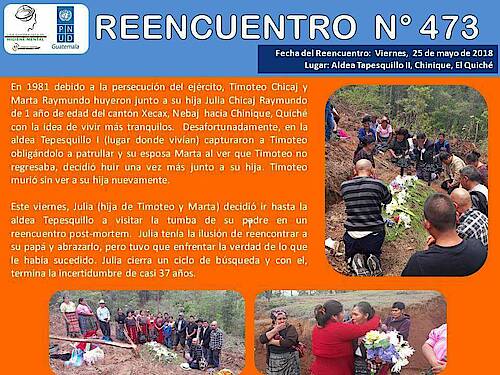
37 años después, hija se reencuentra con su papa de forma post-morten. Es el inicio de esclarecer la verdad y empezar a reparar el dolor de tantos años.
03/28/18
Joint Statement
Bangladesh's incumbent Government has escalated cracking down on the country's opposition prior to the general elections expected to take place by December 2018. The country's Law-Enforcement Agencies regularly demonstrate violent attitudes towards the dissents while the poor situation of Human Rights is highly alarming. (Please click title above to read)
February 1 – 28, 2018
Executive Summary
The year 2018 is considered to be very significant year for Bangladesh as the 11th Parliamentary Election is likely to be held in December 2018. The Awami League led alliance government remains in power since 2009 and in the last 10 years, the government has made different, important government and independent institutions politicized and subservient to it. The Government unilaterally removed the Caretaker Government system in 2011, despite protests from the main opposition BNP, civil society and other political parties, without any referendum, through the 15th Amendment to the Constitution, which created a political crisis. Almost all political parties, including Bangladesh Nationalist Party (BNP) (except Awami League and its alliance) boycotted elections in protest of the removal of the caretaker government system; and the Awami League reassumed power for a second term through controversial and farcical Parliamentary Elections1 on January 5, 2014 and in doing so lost credibility....
Criminalization of politics and violence
Mass arrest of opposition party activists, suppression and
hindrance to freedom of assembly
Dhaka North and South City Corporation polls stayed
Extrajudicial killings
Death in jail
Torture, inhuman treatment and lack of accountability
Enforced disappearances
Public lynching
‘Extremism’ and human rights
Independence of the Judiciary
Interference on freedom of expression and the media
Cabinet approves the draft Digital Security Act 2018
Workers’ rights
Violence against Women
Aggressive policy of Indian government towards Bangladesh
Genocide against Rohingya people in Myanmar
Activities of Odhikar hindered
Please click title to watch on YouTube
Published: 00:05, Nov 20,2017 | Updated: 00:08, Nov 20,2017
POLICE investigators saying that they have found no evidence of any criminal gang being involved in the abduction of North South University teacher Mubashar Hasan Caesar, which took place on November 7, points to a pertinent, yet concerning issue. The teacher, who is an anti-extremism analyst, was picked up from in front of the IDB Building in the capital city 10 minutes after he had left the building. The incident, like any other incidents of enforced disappearance, caused a stir, with family, friends, rights and civic groups demanding that the government should find him out. He still remains untraced. But now that the police have fund no ‘criminal gang’ being involved in the incident, it is the duty of the government and the law enforcement agencies to find out who the people were that have criminally picked him up and where he has been kept. On the other front, Aniruddha Kumar Roy, a businessman and honorary consul of Belarus to Bangladesh, who went missing on August 27, has finally reached, or has been re hed, near his house at Gulshan in the capital. Aniruddha seems to be one of the few of about 402 people who, as rights group Odhikar puts it, disappeared between January 2009 and October 2017 and returned. (Please click title above to continue)
The International Coalition Against Enforced Disappearances (ICAED) expresses its utmost support to ANFASEP for its invaluable role and contribution to the historical memory of Peru. For more than three decades, the long and arduous struggle for truth and justice that Angélica "Mamá Angélica" Mendoza de Ascarza (1928-2017) had started with other strong women of Ayacucho has served as a significant inspiration to other victims of enforced disappearance not only in Peru but also in many other countries across the globe, particularly where the scourge of involuntary disappearance remains to be an ongoing and unresolved phenomenon. Continue here
Manila, 23 de octubre del 2017
PRESIDENTE
PEDRO PABLO KUCZYNSKI
REPÚBLICA DEMOCRÁTICA DEL PERÚ
LIMA-PERÚ.
Excelentísimo señor Presidente:
La Coalición Internacional contra las Desapariciones Forzadas -ICAED- la cual me honra presidir, es una red mundial conformada por 60 organizaciones de derechos humanos y asociaciones de familiares de víctimas en los cinco continentes, trabaja de manera no violenta por la supresión de las desapariciones forzadas y es en sentido que expreso el motivo de la presente:
ICAED valora la histórica adopción, apertura a la firma y entrada en vigor de la Convención Internacional para la Protección de todas las Personas contra las Desapariciones Forzadas, demostrando así el compromiso de la comunidad internacional para desterrar este crimen tan perverso contra la dignidad humana.
De la misma forma valora la ratificación de la Convención Internacional para la Protección de todas las Personas contra las Desapariciones Forzadas por parte del Estado peruano el 2012, así como el reconocimiento de la competencia del Comité de la Convención el 2016 y la consiguiente modificatoria del art.320 del Código Penal referido a la Desaparición Forzada a los estándares internacionales, en enero del 2017.
En razón de ello, ICAED como parte de la comunidad internacional de derechos humanos se encuentra vigilante por el cumplimiento de las normativas, así como de los tratados y convenios internacionales que protegen los derechos humanos y el derecho internacional humanitario de manera fidedigna sin vicios ni impunidad.
Atentamente
KHURRAM PARVEZ
Chairperson
MARY AILEEN D. BACALSO
Secretary-General
10/23/17
Comunicado
Montevideo, 18 de octubre de 2017.
Una vez más la búsqueda de los detenidos desaparecidos se ve ostensiblemente hostigada por provocadores.
Antes habían violentado el despacho del GIAF (Equipo de Antropólogos) y amenazado a los integrantes del mismo. Luego el autodenominado “Comando Barneix”, plantea el chantaje de elegir entre cesar los procesamientos de militares o la vida de connotados luchadores por los Derechos Humanos.
El día domingo 15 de octubre, según versión de la guardia del predio, 3 personas ingresaron en horas de la noche en el Batallón 13, en la zona donde se están realizando excavaciones en búsqueda de restos de detenidos desaparecidos. Ingresaron con un dron que sobrevoló la zona por 20 minutos.
La semana anterior sucedió algo similar en el predio del Grupo de Artillería Antiaérea N° 1 - La Montañesa- Ruta 34, donde también se están realizando excavaciones buscando a nuestros familiares. De ahí roban estacas de madera y rompen el candado del contenedor donde están las herramientas.
Aunque los lugares parecen no haber sido alterados vemos una intencionalidad en estos hechos que nos debe tener alerta.
Las anteriores denuncias, (ataque al GIAF, comando Barneix), todavía sin aclarar, dejaron al descubierto muchas más acciones intimidatorias a abogados e integrantes de equipos que trabajan en el tema.
Nuestra lucha ha estado salpicada de este tipo de hechos, que tienen el claro objetivo de amedrentar a quienes aportan elementos -desde distintos lugares- para la búsqueda de restos y el esclarecimiento de la verdad, y al mismo tiempo intimidar a aquellos que trabajan directamente en el tema.
Estas acciones que repudiamos, llevadas adelante por quienes con uniforme o sin él, sin duda están emparentados con los criminales del pasado, aquellos que aplicaron el Terrorismo de Estado en nuestro país, tienen impulso en la impunidad de la que gozan.
Exigimos de todos los Poderes del Estado una clara, decidida y enérgica respuesta ante estos hechos.
La falta de ella, no haría sino apuntalar su repetición y a quienes, amparados en la impunidad, están dispuestos a seguir operando.
Por Verdad, Memoria, Justicia y Nunca Más Terrorismo de Estado.
Madres y Familiares de Uruguayos Detenidos Desaparecidos
09/28/17
Comisión Nacional de los Derechos Humanos República Dominicana Departamento de Prensa y Comunicación

09/05/17
El derecho de no ser sometido a las desapariciones forzadas: Un imperativo 30 de agosto de 2017
30 de agosto de 2017 - La Coalición Internacional contra las Desapariciones Forzadas (ICAED) rinde homenaje a todos los desaparecidos del mundo. Tan contundente es la importancia de la Federación Americana de Asociaciones de Detenidos Desaparecidos (FEDEFAM) y otras federaciones sobre las desapariciones forzadas (DF) de que las Naciones Unidas adoptaron oficialmente esta ocasión - conmemorada por nuestras hermanas y hermanos latinoamericanos en 1981 en San José, Costa Rica. En el registro del Grupo de Trabajo de las Naciones Unidas sobre Desapariciones Forzadas o Involuntarias (UNWGEID), señalan que existen 43.250 casos pendientes, muchos de los cuales tienen más de una víctima. Esta sin mencionar la subnotificación.
August 30, 2017
On the occasion of the International Day of the Disappeared, we pay tribute to our beloved desaparecidos. To concretize this, the ICAED never tires in knocking at doors of UN member-states to call for their signature, ratification and implementation of the Convention and for the recognition of the competence of the UN Committee on Enforced Disappearance. The provisions of the Convention are more present than ever.
ICAED supports the UN which, today, launches a campaign to double the number of ratifications of the Convention in the next five years. Under the campaign, Stand Up, ICAED has to do its level best to help in achieving at least 114 ratifications in 2022.
The struggle for a world without desaparecidos is far from over.
08/15/17
Declaration
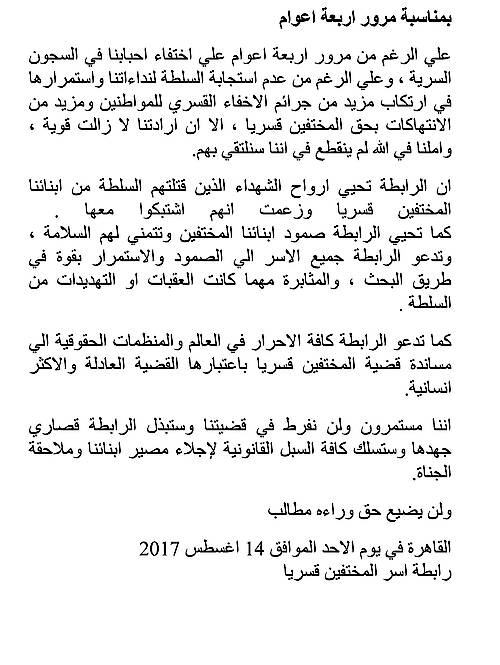
On the occasion of the passage of four years. Despite the passage of four years since the disappearance of our loved ones in secret prisons, and despite the failure of the authorities to respond to our calls; still, they continue to commit more crimes against the rights of citizens and the forcibly disappeared, we believe that if our will remains strong, we will meet them.
The Association salutes the souls of the martyrs, our sons who were forcibly disappeared and killed by the authorities who claimed they were killed in clashes.
The Association also salutes the steadfastness of our disappeared sons and wish them safety. We call all families to withstand and persist vigorously in searching with perseverance, no matter what obstacles or threats they receive from the authority.
The Association also calls upon all free people in the world, human rights organizations and the United Nations to support the cause of the forcibly disappeared as the most just and most humane cause, and to take legal actions to prosecute the perpetrators according to the mechanisms available to them.
We will continue and will never abandon our cause and we will do our best, taking all legal means to detect the fate of our sons and to prosecute the perpetrators. No right will be lost as long as there is someone to claim it.
Cairo on Monday, August 14th, 2017.
The Association of Families of the Disappeared in Egypt
07/06/17
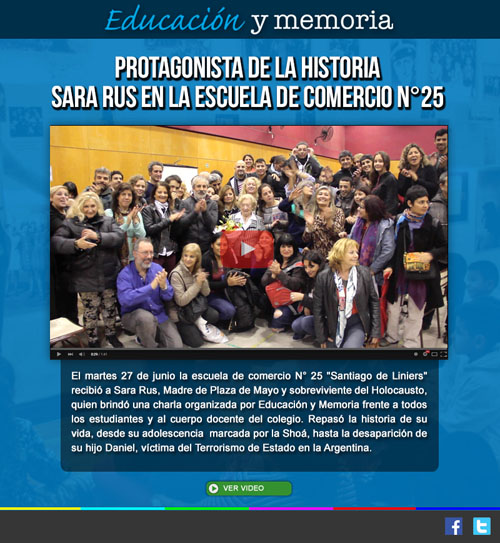
Otra vez los “salvadores” de la Patria
05/29/17
Declaración de la Coalición Internacional contra las Desapariciones Forzadas (ICAED) con motivo de la Semana Internacional de los Desaparecidos.
Para muchas personas la desaparición forzada no es un concepto claro. A menudo, las personas sometidas a desaparición forzada son confunden con personas desaparecidas aunque sean cosas muy diferentes. La desaparición forzada se compone de tres elementos constitutivos: la privación de libertad de una víctima, perpetrada por agentes del Estado o por personas o grupos que actúan con la tolerancia, la aquiescencia o el apoyo del Estado y el rechazo del reconocimiento o la ocultación del destino o el paradero de los desaparecidos.
Una desaparición forzada implica la violación de toda una serie de derechos, civiles o políticos (derecho a la vida, derecho a la integridad física, derecho al reconocimiento como persona ante la ley, derecho a la libertad y seguridad personales) o económico, social o Cultural (derecho a la vida familiar, derecho a un nivel de vida adecuado, derecho a la educación).
Las desapariciones forzadas van en contra de la dignidad humana y del estado de derecho. La desaparición forzada es un crimen contra la humanidad cuando se comete de manera masiva y sistemática. Las víctimas a menudo son torturadas durante el tiempo de su desaparición y son conscientes de que tienen muy pocas posibilidades de que alguien vaya a su rescate causando a ellos ya sus familias una gran desesperación. Incluso si las víctimas son finalmente liberadas el trauma causado y las cicatrices psicológicas y físicas continuarán existiendo el resto de sus vidas. Las víctimas de la desaparición forzada también incluyen a las familias de los desaparecidos que permanecen sin información sobre el destino y el paradero de sus seres queridos durante años, décadas o incluso durante toda su vida. Como resultado, las familias no pueden afligirse y sanar y permanecer sin una respuesta. Las desapariciones forzadas afectan de manera diferente a las mujeres y los hombres, ya que muchas otras cuestiones deben tenerse en cuenta cuando las mujeres se enfrentan a desapariciones forzadas. La mayoría de los centros de detención, ya sean secretos o públicos, carecen de instalaciones adecuadas para atender a las víctimas.
Contrariamente a una creencia popular, la desaparición forzada no es un crimen del pasado, sino un crimen todavía difundido en todo el mundo de hoy y no restringido a ninguna región específica del mundo. Si al principio fue utilizado principalmente por las dictaduras militares, ahora se están cometiendo en diversas situaciones de conflictos internos. El principal motivo detrás de este crimen es aún difundir terror dentro de la sociedad y reprimir cualquier forma de oposición. Las personas de todas las edades y género pueden ser víctimas, pero los jóvenes y los defensores de los derechos humanos están específicamente dirigidos. Por otra parte, incluso si se produjeron casos hace varios años, mientras no se conozca el destino y el paradero de las víctimas, estas desapariciones forzadas son un delito continuo.
La Federación Latinoamericana de Asociaciones (FEDEFAM) conceptualizó por primera vez la Semana Internacional de los Desaparecidos para Familiares de Detenidos Desaparecidos durante su primer Congreso en San José de Costa Rica en 1981. Esta medida que es utilizada por las familias latinoamericanas de los desaparecidos como conmemoración cada año, ha sido adoptada y por familias de víctimas de todo el mundo.
Durante esta Semana Internacional de los Desaparecidos, la Coalición Internacional Contra la Desaparición Forzada (ICAED) desea recordar al mundo la importancia de utilizar las herramientas disponibles para combatir las desapariciones forzadas y en particular la Convención Internacional para la Protección de Todas las Personas contra las Desapariciones Forzadas. Este instrumento, que entró en vigor el 23 de diciembre de 2010, ha sido ratificado por 56 Estados y firmado por 96, situación que todavía está lejos de ser ratificada y aplicada por todos. ICAED hace llama a todos los Estados a acelerar el proceso de ratificación de esta Convención para asegurar la lucha contra la impunidad y la reparación de las víctimas y sus familias en el contexto de la desaparición forzada. También es importante recordar la necesidad de prestar apoyo a las familias de los desaparecidos y enviarles el mensaje de que no están solos en su lucha.
Contacto de prensa: - Punto Focal del ICAED: Mary Aileen Bacalso - fpicaed@gmail.com
05/23/17
Statement of the International Coalition Against Enforced Disappearances (ICAED) on the occasion of the International week of the disappeared.
To many people enforced disappearance is not a clear concept. Often, persons subjected to enforced disappearance are being mistaken for missing persons even though those are very different things. Enforced disappearance is composed of three constitutive elements being: the deprivation of liberty of a victim, perpetrated by agents of the State or by persons or groups that act with the tolerance, acquiescence or support of the State and refused acknowledgment or the concealment of the fate or whereabouts of the disappeared.
05/11/17
CNDH-RD CONDENA REPRESIÓN CON GAS PIMIENTA CONTRA ESTUDIANTES EN ACCIÓN CIUDADANA PACIFICA EN LA PGR
La Comisión Nacional de los Derechos Humanos (CNDH-RD) condena la violenta agresión con gas pimienta de la que han sido objeto algunos estudiantes universitarios independientes, quienes esta mañana han realizado una acción ciudadana pacifica de protesta (y no una ocupación como ha reportado la mayoría de los medios) en la cuarta planta de la Procuraduría General de la República donde está situada oficina del Procurador Jean Alain Rodríguez.
Los jóvenes han entregado un documento condenando la corrupción y la impunidad ya que a pesar de haber transcurrido cinco meses de la revelación en Estados Unidos del escándalo Odebrecht en nuestro país no hay ni una sola persona investigada ni sometida a la justicia.
En el documento se demanda que “de inmediato se oficialice, sin culpables preferidos o de ocasión, el sometimiento de TODOS LOS Y LAS IMPUTADOS/AS, directos/as e indirectos/as en la trama de los sobornos, sobrevaluaciones y financiamientos ilícitos de Odebrecht, así como la investigación inexcusable de todos los funcionarios y empresarios involucrados en la gestión de las obras locales de la multinacional, incluyendo al presidente Danilo Medina y a los expresidentes Leonel Fernández e Hipólito Mejía”.
La Comisión Nacional de los Derechos Humanos comunica que ha informado las organizaciones defensoras y promotoras de los derechos humanos internacionales nuestras aliadas, como la Federación Internacional de los Derechos Humanos (FIDH) y Amnistía International, tanto de la situación que estamos viviendo en el país respecto a la corrupción e impunidad, cuanto del creciente clima de intolerancia y represión alrededor de los integrantes del movimiento Marcha Verde y de cada ciudadano que salga a condenar públicamente la corrupción y la impunidad que reinan en República Dominicana, como se dio hoy con estos jóvenes.
“Condenamos que las autoridades dominicanas en el día de hoy hayan dado una vez más demostración de intolerancia y hayan demostrado también que la única respuesta que reciben los ciudadanos honestos y honrados al reclamar en contra de un sistema corrupto que cada día sustrae recursos cuantiosos a las políticas públicas necesarias para nuestra población, es la de la represión y violencia” ha declarado el Dr. Mercedes, presidente de nuestra organización, quien ha estado en la Procuraduría brindando atención a los jóvenes y mediando para la realización del dialogo con las autoridades.
Eso es aún más grave cuando la intolerancia y la represión son dirigidas contra la juventud la cual tiene el derecho y también el deber de luchar contra la corrupción ya que es propio a los jóvenes a quienes principalmente esta afecta porque que les está robando el futuro.
La Comisión Nacional de los Derechos Humanos informa finalmente que se mantendrá alerta y vigilando ante esta fase represiva, respecto a cualquier acción de violación de los derechos humanos y fundamentales de los ciudadanos dominicanos quienes de forma independiente expresan su indignación contra la corrupción y la impunidad y de todos los ciudadanos involucrados en el movimiento Marcha Verde.
Santo Domingo, D.N.
9 de mayo 2017
Comisión Nacional de los Derechos Humanos
República Dominicana
Departamento de Prensa y Comunicación
03/17/17
Boletín informativo FRAY ANTÓN DE MONTESINOS N. 5/17 del 13 al 19 de marzo de 2017
04/18/17
ADVOCACY FORUM - Press Release
03/08/17
8 de Marzo #Nunca más #Ni una menos
04/06/17
REENCUENTRO N° 448
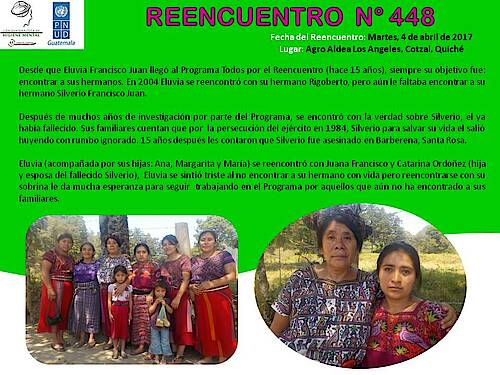
Con la alegría que la vida nos permite seguir acompañando a familiares víctimas del conflicto, les compartimos el último reencuentro familiar realizado el día de ayer 4 de abril. "LA VIDA SIEMPRE SE ABRE CAMINO"
05/23/16
Statement of the International Coalition Against Enforced Disappearance (ICAED) on the Commemoration of the International Week of the Disappeared
The clamor of the families of victims of enforced disappearance from across the globe to resurface and bring back their disappeared loved ones is louder than before. Another year has passed and although a significant number of milestones have been achieved in the collective struggle against this painful phenomenon, enforced disappearance continues to traumatize the lives of innocent families worldwide.
In the August 2015 Report of the United Nations Working Group on Enforced or Involuntary Disappearances (UN WGEID), the number of cases under active consideration stands at 43, 563 in a total of 88 states[1].It is plausible to theorize that the continuing occurrences of enforced disappearance is associated with the States’ lack of sufficient legal mechanisms and frameworks that will safeguard the lives of its citizens from the cruel act of enforced disappearance. The UN Convention for the Protection of All Persons from Enforced Disappearance, which is an international legal instrument that was adopted to address the issue, is faced with different political challenges. As of May 2016, many countries have yet to sign and ratify the Convention and those which have ratified have yet to recognize the competence of the Committee on Enforced Disappearances.
In Asia, only 6 out of 52 countries ratified, 11 countries signed, and 35 countries have no action on the Convention. The Philippines is also the only country in Asia that has a domestic law against enforced disappearance while Sri Lanka was the latest to sign the Convention. In Africa, 11 countries have already ratified, 27 signed, and 26 countries have no action. In Europe, 15 countries ratified, 29 countries signed, while 15 countries have no action. In South America, 9 countries ratified, 9 countries signed, and 4 countries remain with no action. In North America, only 6 countries ratified, 8 signed, and 21 countries have no action. Finally in Oceania, only 1 country ratified, 3 signed, and 11 remains with no action[2].
It is also important to note that although many countries ratified the Convention, many of them have not yet recognized the competence of the Committee on Enforced Disappearance (CED). Only 20 countries recognize the competence of the CED out of the 48 countries that have ratified the Convention.[3]
Enforced Disappearance is still a tool of repressive governments to paralyze their political enemies and other innocent communities. In a recent report in Bangladesh, 8 cases of enforced disappearance happened and documented in January 2015 - April 2016. In Bangladesh, enforced disappearance is one of the primary acts perpetrated by law enforcement agencies, paramilitary, and armed forces to detain and even extra-judicially execute individuals.
In Mexico, 545 cases of enforced disappearances have already been transmitted by the UN WGEID to the government from 1980 to 2015. Out of the 545 cases, 43 involved female victims and 68 victims were eventually found dead. In a more recent incident on September 2014, 43 students from the Escuela Normal Rural Raúl Isidro Burgos in Ayotzinapa were subjected to enforced disappearance in Iguala, state of Guerrero. The burned remains of one of them were found weeks later. The other 42 are still missing.[4]
Europe was not spared of the inhuman crimes of enforced disappearance. In Belarus, political disappearances of four persons have not been properly investigated since 1999 despite the fact that the Council of Europe in 2004 produced the report Disappeared Persons in Belarus and demanded the government to take appropriate measures.
Enforced disappearances continue to be a challenge in Zimbabwe as well and currently human rights activists are concerned about the disappearance of human rights activists Paul Chizuze and Itai Dzamara in 2012 and March 2015 respectively. The concern is that it seems the state is not moved by the disappearance of its citizens and the clarion call is for Zimbabwe to come up with legislation against this crime against humanity. Enforced disappearances bring untold suffering to families who are traumatized by the disappearance of a loved one.
On the occasion of this year’s International Week of the Disappeared, ICAED and its 55 member-organizations are now calling on Governments who have not yet signed and ratified the Convention and who have not yet enacted domestic legislation to do so without further delay.
SIGN AND RATIFY THE CONVENTION NOW!
RECOGNIZE THE COMPETENCE OF THE COMMITTEE ON ENFORCED DISAPPEARANCES!
ENACT DOMESTIC LAWS CRIMINALIZING ENFORCED DISAPPEARANCES!
STOP ENFORCED DISAPPEARANCES NOW!
Mary Aileen D. Bacalso
Focal Person
International Coalition Against Enforced Disappearances
[1] A/HRC/30/38 Report of the UN Working Group on Enforced or Involuntary Disappearances
[3] Declarations recognizing the competence of the CED under Article 31 and 32
[4] Amnesty International Timeline Report, https://www.amnesty.org/en/latest/news/2015/09/mexico-ayotzinapa-student-s-enforced-disappearance-timeline/
Every last week of May, we commemorate the International Week of the Disappeared (IWD), a painful reminder that thousands of families still await information on the fate of their loved ones who have disappeared and thousands of disappeared persons are waiting to be freed from the unknown prisons where they are kept. The IWD was incepted by the Latin American Federation of Associations for Relatives of Disappeared-Detainees (FEDEFAM), which, in turn, was adopted by families of the disappeared across the world.
The International Coalition Against Enforced Disappearances (ICEAD) and its 53 member-organisations campaign for the universal ratification and implementation of the International Convention for the Protection of All Persons from Enforced Disappearance (ICPED), the recognition of the competence of the UN Committee on Enforced Disappearances and the enactment of domestic laws criminalizing enforced disappearances. It is the most emblematic way to pay tribute to the disappeared and their families.
Download the statement here and continue reading
You can also download the statement in Russian, French and Spanish
Today, 23 December 2014 marks the 4th anniversary of the entry into force of the International Convention for the Protection of All Persons from Enforced Disappearance (Convention) after the 20th instrument of ratification was deposited by Iraq. Four years after the entry into force of the Convention, this treaty, whose provisions originate from the concrete sufferings of the families of the disappeared, has garnered 44 ratifications and 94 signatories, with Slovakia being the most recent State Party and Angola as the most recent signatory. Yet of the 94 States Parties, only 18 States have recognized the competence of the Committee on Enforced Disappearances (CED).
With the 84 states having outstanding cases submitted to the UN Working Group on Enforced or Involuntary Disappearances, universal ratification of the Convention is far from being realized. The United Nations Working Group on Enforced or Involuntary Disappearances (UN WGEID) reports of 42,889 active cases it has received from 84 states. Multiplied by the number of family members, relatives and friends who suffer from the effect of enforced disappearance, each case is not just part of statistics but it signifies tremendous human sufferings caused by states which are supposed to be protectors of human rights.
Download the statement here and continue reading.
You can also download the statement in French

End Enforced Disappearances!
End Impunity!
We must not forget the important historical lessons from the thousands of activists, children and innocent citizens who disappeared in Latin America at the height of the military and civilian dictatorships in the 70s and 80s. Many of those who disappeared chose to question the failure of many governments to implement measures that will address poverty, unemployment and promote civil, political and economic liberties of the people. Since then, the phenomenon of enforced disappearance has continued to spread throughout the world.
The strong commitment of our colleagues in Latin America to search for the disappeared loved ones, and to journey for justice is a very powerful force that continues to inspire the world until today. In 1981, the Latin American Federation of Associations for Relatives of Disappeared Detainees (FEDEFAM) chose the 30th of August as the International Day of the Disappeared. This action institutionalizes the campaign against forced disappearances and the inhumane practices of detaining and torturing dissidents and opposition members in undisclosed prisons. The International Day of the Disappeared gained official international recognition by the United Nations in 2010.
Download the statement here and continue reading.
Statement of the ICAED International Week of the Disappeared
The International Week of the Disappeared was globally celebrated from the 26th to the 31st of May. To mark this important annual remembrance the ICAED published this statement.
"This week we commemorate the International Week of the Disappeared, first initiated by the Latin American Federation of Associations of Relatives of Disappeared-Detainees (FEDEFAM) in 1981 and adopted by many organizations of families of the disappeared and civil society organizations world-wide. The commemoration was also meant to step up the campaign against enforced disappearances which were then at their peak during the dark years of the dictatorship in many Latin American countries. Working hard to realize the dream for a world without enforced disappearances is our most important tribute to the desaparecidos.
The International Coalition Against Enforced Disappearances (ICAED), which has 52 member-organizations from various parts of the globe, gives tribute to the disappeared and their families. A fitting tribute to them is the concretization of its mandate to campaign for the universal ratification and implementation of the International Convention for the Protection of All Persons from Enforced Disappearance (CED), the recognition of the competence of the UN Committee on Enforced Disappearances and the enactment of domestic laws criminalizing enforced disappearances. This strong international human rights instrument for prevention of recurrence of enforced disappearances provides for the right NOT to be subjected to enforced disappearances. Stemming from real-life experiences of victims of enforced disappearances, this treaty provides, among other things, the right to truth and justice and the right not to be subjected to enforced disappearance. It considers enforced disappearance as a continuing offense and holds States proven to have committed enforced disappearances, responsible for the acts committed by its agents. It has strong provisions on truth, justice, reparation and guarantees of non-recurrence [...]"
Continue reading this statement downloading the full version in English, Spanish or French below.
FINAL_2014_ICAED_IWD_STATEMENT.pdf 2014 ICAED IWD Statement English |
Traduction_declaration_spanish.docx 2014 ICAED IWD Statement Spanish |
2014 ICAED IWD Statement French |
ICAED RISING UP: A Unity Statement
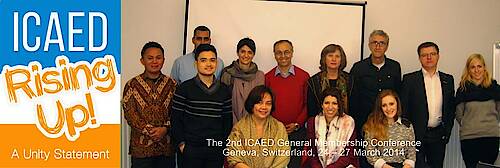
The 2nd ICAED General Membership Conference, Geneva, Switzerland, 24 – 27 March 2014
We, human rights organizations from
Belarus, Cyprus, Indonesia, Morocco, Philippines, Switzerland, Western Sahara, including the online participation of organizations from France, El Salvador, Guatemala, Peru, Thailand, Uruguay, gather here in Geneva, Switzerland during the last week of the 25th session of the UN Human Rights Council in the spirit of international solidarity to step up our global campaign for the universal ratification and full implementation of the UN Convention for the Protection of All Persons from Enforced Disappearance. We evaluated our work; read the signs of the times on the phenomenon of enforced disappearance in our respective countries; and sharpened our strategies in campaigning for the end of enforced disappearance and impunity worldwide.
We renew our common commitment to attain a world without disappeared people.
Enforced Disappearance: A Present Global Problem
Even after the long years of struggle against this most heinous of human rights violations, someone, somewhere is still disappeared or is under the threat of being disappeared by repressive and non-repressive governments in many parts of the world. Enforced disappearance violates the most basic rights of a person – the right to security and dignity, right to fair trial, right not to be tortured, right to truth, right to have effective investigation and remedies, right to family life, and when the disappeared is killed, the right to identification and proper burial or cremation. Its persistence is a grave threat to the values and principles that we hold dear as democratic societies. Without an appropriate and urgent response, more will add to the long list of desaparecidos worldwide.
The total number of cases transmitted by the Working Group to Governments since its inception is 53,986 The number of cases under active consideration that have not yet been clarified, closed or discontinued stands at 42,889 in a total of 84 States. These numbers do not take into account the massive underreporting of cases in many countries in the world. From the reports of the Working Group, different human rights organizations, specially our member organizations, disappearances are still happening in alarming numbers in Asia, the Euro-Mediterranean, Africa and even Latin America, among other regions [...]
Download the full statement here in English and French (Spanish coming soon)
ICAED_Unity_Statement_Mar_2014.docx ICAED Unity Statement English |
ICAED_Unity_Statement_Mar_2014_français.docx ICAED Unity Statement French |
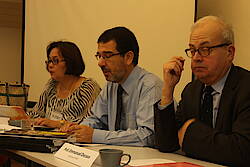
Extract of the keynote speech by Emmanuel Decaux President of the Committee on Enforced Disappearances, on the opening of the ICAED Meeting
"The annual meeting of the ICAED is a very important opportunity to liaise with you, as well as with others stakeholders. Unfortunately, I know that a lot of members of the coalition were not able to come to Geneva, due to financial restraints or other commitments. I will ask to your chairperson, Ms Mary Aileen Bacalso, to send to them all my best wishes, on behalf of the Committee on enforced disappearances, and to hope that next year they could have the same opportunity to liaise directly with UN bodies and State parties, here, in Geneva.
I used to say that the convention is “victim-oriented”, it is not a formula, it a strong commitment for each member of the Committee, in exercising our duties and or responsibilities. The courageous and perilous work of grass-root organizations, in difficult situations is the frontline for the defense of human rights and specially the fight against enforced disappearance. It is an “anonymous crime” and to break the wall of silence and fear, is the first step to trigger international protection. We need the information from the family and the relative, from the grass-root organizations working on the turf as well as front the strong network of international NGOs, with your regional groups and the ICAED.
As you know, after formal consultations, the Committee adopted a strong position about the cooperation with civil society. The openness of reporting process, under article 29, depend of the contribution of all stakeholders, as well as the appeal for urgent actions, according to article 30, or the files of article 33 about country visit after credible allegations of gross violations of the CED. We are working in the same way to draft a paper on the cooperation with Human Rights National institutions which will be put on the website of the Committee for comments."
(Click on the title to download the complete keynote speech)
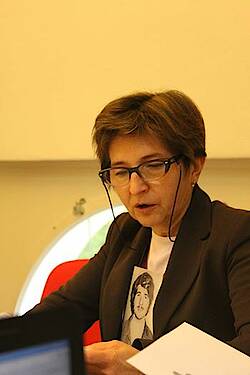
ICAED Meeting Geneva 2014: Bettancourt remembers her disappeared brother
TESTIMONY
Francisco, my brother, every time I look at your photo I realize you did not changed. I know that you are somewhere in this planet; but you're not. That yes, you changed, maybe you got old in moments of pain, that you suffered and your hair, your face, your clothes are now different...
We searched for you everywhere, we scanned the horizon and the letters, we expected a phone call, we hoped someone had seen you in the jails of the dictatorship. We even talked to the traitors for some clues, some hint that confirmed us that you had been seen somewhere. We wanted to convince ourselves that you had succeeded escaping from the clutches of the executioners.
When I arrived here to Geneva after ten years of dictatorship I wanted to believe that you could still be hidden somewhere or in the exiled. I made calls through radio and magazines, I contacted your former colleagues, but I could not get more than confirmation that you had been a victim of enforced disappearance in your own country:
Pinochet 's henchmen had made you disappear!
I know that the Convention for the Protection of All Persons from Enforced Disappearance will not make you come back alive, not even those who made you disappeared will face trial, but I know that this Convention will, now and in the future, be an obstacle to tyrants and that this scourge will stop someday.
Other sons, brothers, fathers, husbands won’t disappear leaving an immense void in society and in their families.The only way that this can be an effective, efficient and lasting convention, is that all countries ratify it and accept the committee and that all human rights are respected.
With this Convention new rights have been born, and I want to emphasize that one is the right "not to be disappeared."
Brother, brothers, I want you all to know that we do not forget....
Thank you,
Jenny Bettancourt